

Chest pain in women is not always straightforward. It can appear as chest tightness, pressure, burning, or discomfort, and may signal anything from minor irritation to a serious medical emergency such as a heart attack or pulmonary embolism. In many cases, the pain does not present as the classic “crushing” sensation and may instead spread to the neck, jaw, shoulders, or back, making it easier to overlook.
These symptoms often occur alongside shortness of breath, nausea, dizziness, unusual fatigue, or sweating, and can be mistaken for digestive issues, anxiety, or muscle strain. Because chest pain in women can be subtle yet serious, recognizing these patterns is critical. Understanding the underlying causes helps identify warning signs early and determine when immediate evaluation at a Laredo emergency room is necessary.
Causes of Chest Pain in Women
Chest pain in women can result from a wide range of conditions, including heart problems, lung issues, digestive disorders, muscle strain, or anxiety. While the most serious cause is a heart attack, many cases are linked to non-cardiac conditions such as acid reflux or stress. Because symptoms can overlap, it is not always possible to determine the cause based on symptoms alone. Even mild or intermittent chest pain may signal a serious underlying issue. If chest pain occurs along with shortness of breath, nausea, dizziness, or pain radiating to other areas, it should be treated as a medical emergency and evaluated at an ER near me.
Heart-related causes of chest pain in women:
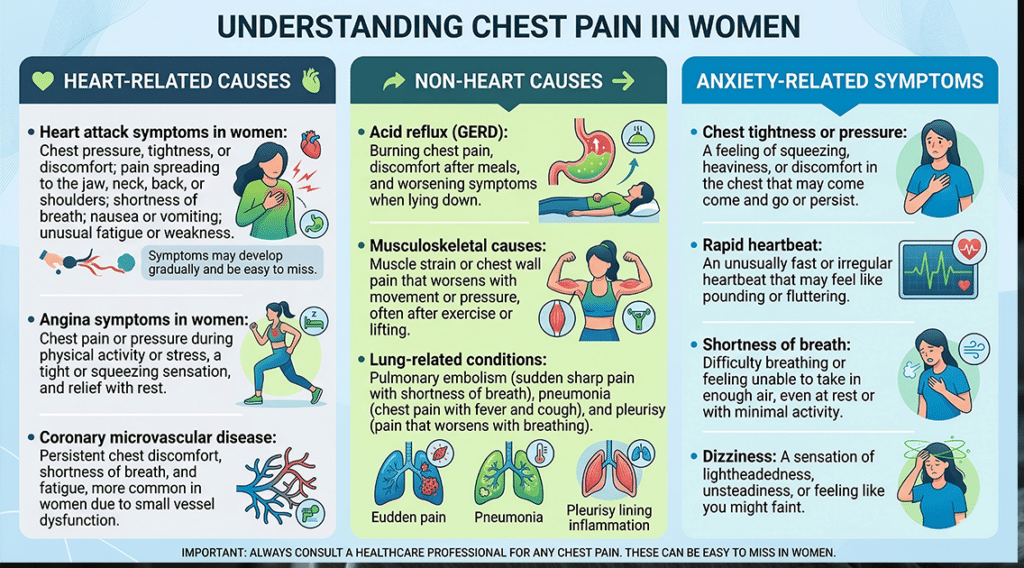
- Heart attack symptoms in women: Chest pressure, tightness, or discomfort; pain spreading to the jaw, neck, back, or shoulders; shortness of breath; nausea or vomiting; unusual fatigue or weakness. Symptoms may develop gradually and be easy to miss.
- Angina symptoms in women: Chest pain or pressure during physical activity or stress, a tight or squeezing sensation, and relief with rest.
- Coronary microvascular disease: Persistent chest discomfort, shortness of breath, and fatigue, more common in women due to small vessel dysfunction.
Non-heart causes of chest pain in women:
- Acid reflux (GERD): Burning chest pain, discomfort after meals, and worsening symptoms when lying down.
- Musculoskeletal causes: Muscle strain or chest wall pain that worsens with movement or pressure, often after exercise or lifting.
- Lung-related conditions: Pulmonary embolism (sudden sharp pain with shortness of breath), pneumonia (chest pain with fever and cough), and pleurisy (pain that worsens with breathing).
Anxiety-related chest pain in women:
- Chest tightness or pressure: A feeling of squeezing, heaviness, or discomfort in the chest that may come and go or persist.
- Rapid heartbeat: An unusually fast or irregular heartbeat that may feel like pounding or fluttering.
- Shortness of breath: Difficulty breathing or feeling unable to take in enough air, even at rest or with minimal activity.
- Dizziness: A sensation of lightheadedness, unsteadiness, or feeling like you might faint.
Panic attacks can closely mimic a heart attack, making medical evaluation essential to rule out serious causes.
Left Side vs Right Side Chest Pain in Women
Chest pain location can sometimes provide clues, with left-sided pain more commonly linked to heart-related issues and right-sided pain often associated with muscle strain, lung conditions, or digestive problems. Regardless of the side, any persistent, severe, or unexplained chest pain should be evaluated promptly at STAT Specialty Hospital.
Left Side Chest Pain in Women
- More commonly associated with heart-related issues
- May radiate to the arm, jaw, or back
- Requires urgent evaluation
Right Side Chest Pain in Women
- Often linked to muscle strain or lung conditions
- May also result from digestive issues
Regardless of location, persistent or severe chest pain should never be ignored.
Chest Pain Symptoms in Women You Should Never Ignore
Certain symptoms may indicate a life-threatening condition and should never be ignored. Recognizing these warning signs early can help ensure timely medical attention and prevent serious complications. Watch for the following symptoms:
- Chest pressure, tightness, or squeezing
- Pain spreading to the arms, jaw, neck, or back
- Shortness of breath
- Nausea or vomiting
- Sudden dizziness or fainting
- Cold sweats
- Extreme or unusual fatigue
These symptoms may signal a heart attack or another serious condition requiring immediate care. Anyone experiencing chest pain should seek evaluation at an ER for chest pain without delay.
When Chest Pain in Women Becomes Dangerous
Chest pain in women becomes dangerous when it is sudden, severe, or accompanied by other concerning symptoms. Recognizing these warning signs early is important, as they may indicate a serious underlying condition that requires immediate medical attention. Watch for the following symptoms:
- Chest pain lasting more than a few minutes
- Pain that comes and goes but worsens
- Difficulty breathing
- Rapid or irregular heartbeat
- Confusion or fainting
Delaying care in these situations can lead to severe complications, including heart damage, stroke, or death.
When to Go to the ER
Chest pain should be treated as an emergency if it is severe, persistent, or accompanied by symptoms such as shortness of breath, dizziness, nausea, sweating, or pain spreading to other areas. Prompt evaluation is critical to rule out life-threatening conditions and begin immediate treatment if needed.
- Severe or persistent chest pain
- Chest pain with shortness of breath
- Pain radiating to the jaw, neck, or arm
- Sudden nausea, sweating, or dizziness
- Fainting or near-fainting
- Symptoms that feel like a heart attack
- Chest pain after physical exertion or stress
These symptoms require immediate evaluation in an emergency setting where life-saving treatment is available.
How Chest Pain in Women Is Diagnosed
Diagnosing chest pain in women involves a combination of medical history, physical examination, and diagnostic tests to quickly identify the underlying cause. Since symptoms can vary and sometimes present atypically, multiple tests are often used to rule out serious conditions. Early and accurate diagnosis helps guide appropriate treatment and prevent complications.
- Electrocardiogram (ECG): Detects heart abnormalities
- Blood tests: Identify heart damage markers
- Chest X-ray: Evaluates lungs and heart
- CT scan: Detects clots or structural issues
- Stress testing: Assesses heart function
Early diagnosis helps guide treatment and prevent complications.
Emergency Care for Chest Pain at STAT Specialty Hospital
Chest pain can escalate quickly and requires prompt evaluation. At STAT Specialty Hospital, patients experiencing chest pain in women receive immediate, expert care from highly trained emergency professionals. What You Can Expect:
- Rapid Assessment: Immediate evaluation of chest pain symptoms and vital signs
- Advanced Diagnostics: On-site ECG, imaging, and laboratory testing
- Continuous Monitoring: Cardiac monitoring to detect abnormalities
- Targeted Treatment: Medications, oxygen therapy, and stabilization
- Specialist Coordination: Access to cardiology and advanced care when needed
Timely intervention can significantly improve outcomes and prevent life-threatening complications.
Key Takeaways
- Chest pain in women can have many causes, including heart, lung, digestive, or anxiety-related conditions.
- Heart attack symptoms in women are often subtle and different from those in men.
- Even mild or intermittent chest pain should not be ignored.
- Symptoms like shortness of breath, nausea, or dizziness increase urgency.
- Immediate medical evaluation is critical to rule out serious conditions.
- Emergency care ensures rapid diagnosis and life-saving treatment.
Frequently Asked Questions
What is the most common cause of chest pain in women?
Chest pain in women is commonly caused by conditions such as acid reflux, muscle strain, or anxiety. However, it is important to first rule out heart-related issues, especially when symptoms are sudden, severe, or unexplained.
How do I know if chest pain is serious?
Chest pain may be serious if it occurs with symptoms like shortness of breath, dizziness, nausea, or pain that spreads to other parts of the body. If the pain is persistent, worsening, or accompanied by these warning signs, immediate medical evaluation is necessary.
Can stress cause chest pain in women?
Yes, stress and anxiety can lead to chest tightness or discomfort. Since these symptoms can closely resemble heart-related conditions, it is important to seek medical evaluation to rule out any serious underlying causes.